Ari Collins: Who are you?
Natalie Gray: “My name is Natalie Gray, I’m the director of youth services at the Arts Commission in Toledo, Ohio.”
AC: “Amazing. How are you involved with the art scene in Toledo?”
NG: “Through my work at the Arts Commission, I get to be involved with the young creatives in Toledo. I also get to go to a bunch of free family events that are put together through the arts. In general, I like to support local artists. I go see live music and live theatre. I work with Issue Box Theatre, Toledo Streets Newspaper. I think that the arts are the culture of the community, so for me it’s always so fascinating.
Of course, I went to Toledo School for the Arts 6-12. My brother went there, my parents are artists. So it’s just something I’ve grown up with. Going to Toledo School for the Arts made me appreciate all of the work that people put into doing art. I learned, I got to train for free. I got to take dance classes, poetry classes, photography classes and theatre. That kind of instilled in me the value of having those tools, so I kinda ended up staying in the arts world for my career.”
AC: “Cool! So how has the art in Toledo impacted you personally?”
NG: “Well it has mainly impacted me because it’s my job, but growing up and being able to learn what my body can do through dance; and, learn empathy through theatre; and, expression through poetry was just really helpful. I think art is everything. Art is just trying to process what life is. It’s a really important part of bringing people together and helping each other understand things that we go through.
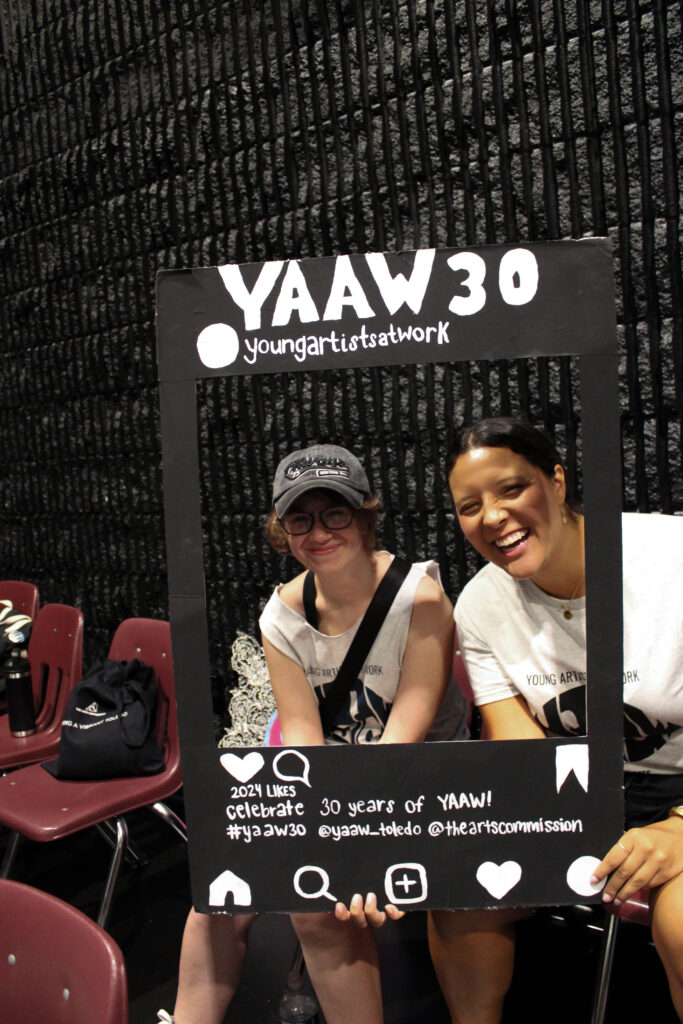
Gray told me: “My personal favorite part about Young Artists at Work is I’ve been able to watch young people grow over their whole high school career. That, to me, is such a privilege.”
It also just makes everything more palatable. It’s much easier to listen to a song or watch a play that deals with real issues than it is to just open up to somebody and be vulnerable. Personally I think it’s helpful to people for healing. And of course it’s just fun. It’s fun, it makes our city more beautiful and vibrant. It brings people together.
I don’t think everyone interacts so intentionally with art everyday–and I would like people to one, have more access to it and make it more accessible–but people unintentionally interact with art every single day. We’re wearing clothes, we’re putting stickers on our water bottles, we’re eating food. That’s all creative.”
AC: “Why is it important to create these communities and why or how does art help do that?”
NG: “Humans need to have community. Social cohesion and interaction is a social determination of health. Why is it important to have community? It’s so important to move your body and connect with other people intergenerationally. I always say this: the only thing that cultures have in common is art and God. When we’re studying an ancient culture or another part of the world, that’s what we look at. We look at their religion and their art, and oftentimes they go hand in hand. There is architecture and stained glass and music and sculptures that are sacred. It’s a part of religion, people know how important that is. And vise versa, art is sacred. It’s honoring your body, your expression and your time here on Earth.”
AC: “Yeah, definitely.”
NG: “I like to create opportunities to sing with your community and dance with your community and come together regularly outside of the religious context. Because it is quite spiritual but it doesn’t have to be, and we can do that through these organizations. Art is another way to bring people together that’s healthy and safe, hopefully.”
AC: “So, the Arts Commission helps foster community. I guess why or how do you, within that organization, do that?”
NG: “I think the Arts Commission prompts people to come together through creativity and meet other people and that’s the really important part of creating a community. When I was in high school in 2014, I got to read one of my poems at an Arts Commission event and I got to meet all these different artists and see all these different installations and stages. It really inspired me. Oh, Toledo has cool stuff going on. And then I started volunteering for the organization for the art loops. And in 2015 they had another Art-O-Matic event and I got to meet a lot of the people I know.
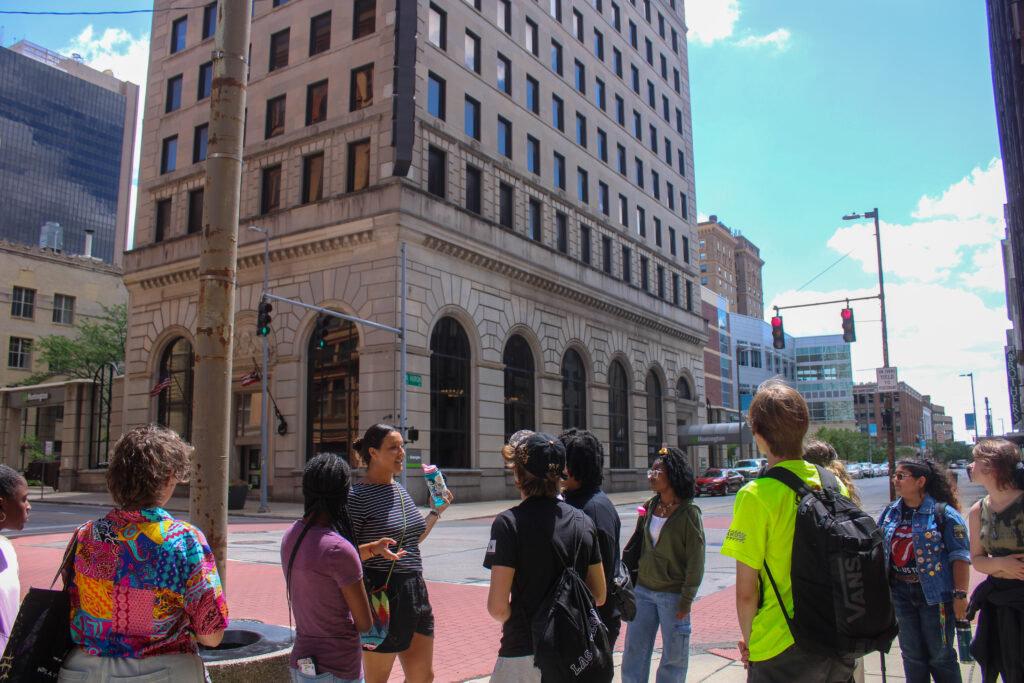
Why do they do it? You almost don’t know why until ten years later and you’re talking to a young person who is asking you about how the arts impacted you because clearly it impacted them. You know, that’s why they do it. Because one day, you know, we have all these young people. You know, we create community through Young Artists at Work and for thirty years these teens have been getting paid to meet each other and make art together and come together that would’ve never — you know, urban kids and suburban kids, poor kids [and] rich kids all care about art and come together. That’s why we keep doing it.
That’s a little bit of how and a little bit of why and some examples. But I mean, superficially, it’s fun. More emotionally, you see the impact over time. I didn’t that when I was reading my poem when I was 17 that I would then work at the organization when I was 27. It’s really hard to measure that kind of impact because it’s so widespread and we don’t know how people are going to remember these things.
The First Art-O-Matic I went to was in 2004, and now it’s 2024. One thing that’s special about the Arts Commission is it’s not a museum and it’s not a school. You don’t have to pay to participate. In fact, we’re really focused on paying artists because we believe that art is work and we should value that in the economy.”

 Reclamation